

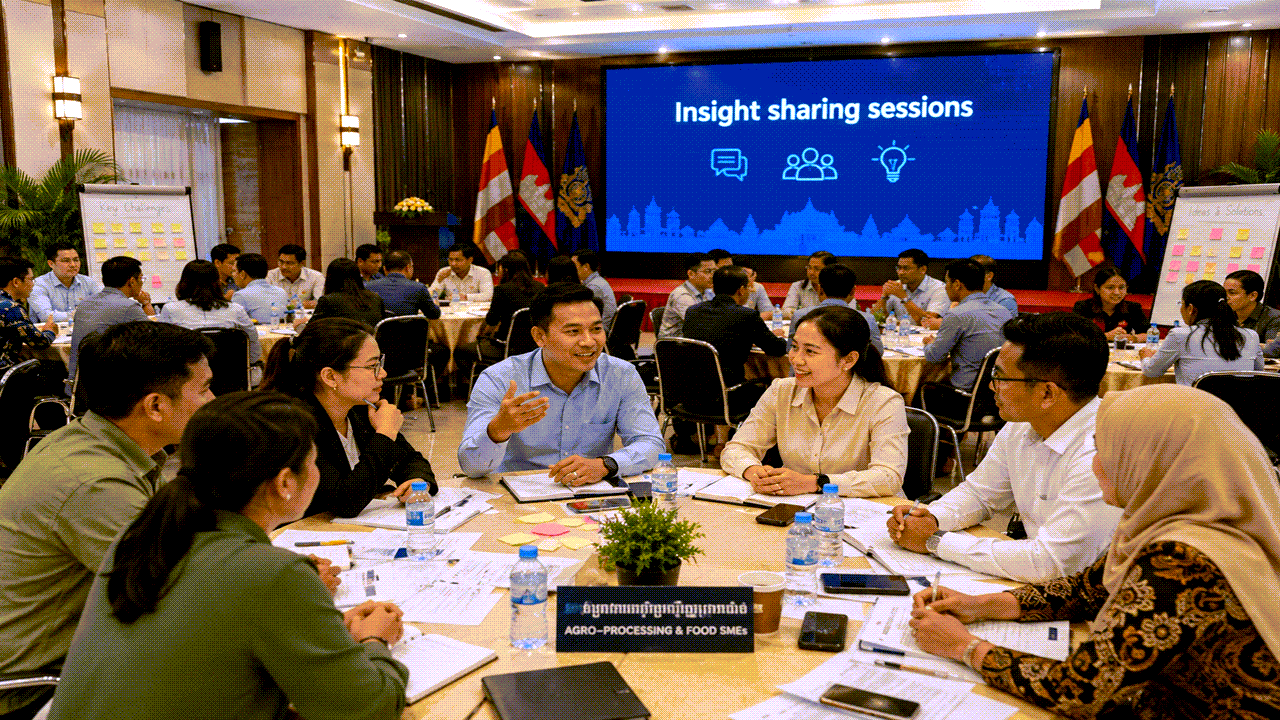
Listening to Cambodian SMEs across the country, such as farmers, producers, processors, traders, and business association representatives I recently met in Battambang, offers vital insights into the real-world constraints and opportunities missing from official statistics and policy documents. Despite their diverse challenges, their concerns center on one core question: What can we do to make it easier for businesses to start, operate, compete, and grow?
This question is simple, but the answers are often complex, and they tell us a great deal about where business environment policies can make a practical difference.
Making formalization easier for micro and small businesses
One concern was the cost of formalization. For a larger company, registration or certification fees may be relatively small compared with overall operating costs. For a newly established micro-business, however, these costs can matter significantly. Businesses also face continuing obligations after registration, including renewals, certifications, tax compliance, and other administrative requirements.
These concerns are particularly relevant when businesses are already facing a more difficult economic environment. Global uncertainty, geopolitical tensions, and disruptions to trade and supply chains have contributed to pressure on input prices, energy, and logistics costs. Smaller businesses, with limited cash reserves and thinner margins, are often more vulnerable to these pressures.
If we want more businesses to formalize, perhaps we need to think more creatively about graduated or transitional compliance arrangements for newly established micro and small businesses. Could some procedures be simplified? Could administrative requirements be consolidated? Could businesses receive clearer guidance on their obligations after registration? The objective should not be to remove legitimate requirements, but to ensure that compliance is proportionate to the size, capacity, and risk profile of the business.
Businesses need markets, not just information
Another concern was market access and business matching. Many SMEs want to expand but do not know where to find buyers, partners, or relevant support programs. This is particularly challenging for smaller businesses without dedicated sales or marketing teams.
There is therefore a role for stronger market intelligence and business matching mechanisms, including buyer-seller meetings, sector-specific business matching, export-readiness programs, and targeted information sessions. For an SME, knowing that an opportunity exists is useful. Knowing who the buyer is, what the buyer requires and how to reach them is much more useful.
Competitiveness is also about the cost of production
Businesses also raised concerns about high production and processing costs. This matters for Cambodia’s ambitions to move towards higher-value production and exports. If businesses face high input, processing, logistics, or compliance costs, they may struggle to compete even where market demand exists.
Some solutions lie within individual firms: better technology, production processes, quality management, energy efficiency, packaging, and processing capabilities. But we also need to look beyond the firm. For example, a food processor may face high electricity costs; an agricultural producer may face expensive transport because of poor road access; an exporter may experience delays because testing or certification services are not readily available; and a small manufacturer may spend considerable time navigating fragmented administrative procedures. These are business ecosystem issues, requiring attention to infrastructure, logistics, utilities, regulation and access to appropriate business services.
Finance and skills remain critical
Access to finance remains another important issue for Cambodian SMEs. The question is not simply whether finance exists, but whether it is accessible, affordable, and suitable for different types of businesses.
Likewise, businesses continue to face shortages of skilled workers. We need to connect TVET and workforce development more closely to actual private-sector demand. Instead of asking only “What training can we provide?”, we should also ask: “What skills are businesses actually unable to find?”. Stronger partnerships between businesses, chambers, training institutions, and government could help create a more demand-driven provincial skills ecosystem.
Agriculture needs timely support
Agricultural businesses and farmers also face sector-specific challenges, including concerns over emerging crop diseases and the availability and appropriate use of fertilizers and pesticides.
Agricultural problems require timely responses. By the time a disease becomes widespread, significant losses may already have occurred. This highlights the importance of responsive agricultural extension, timely technical information, and practical support reaching farmers and agro-processors when they need it.
The role of provincial government
Many of these issues also demonstrate why provincial government matters in improving the business environment. Road access, local infrastructure, public services, skills development, investment facilitation, agricultural extension, and coordination among provincial departments all have a direct bearing on businesses.
This is where structured provincial public-private dialogue can play an important role. A good dialogue should be more than a forum for businesses to list complaints. It should provide a mechanism to document, clarify, prioritize, and follow up issues, while identifying which matters can be addressed locally and which require escalation to the national level. The real measure of success is therefore not how many issues businesses raise, but what happens to those issues afterwards.
From listening to policy actions
Many of the issues Cambodain SMEs raise are not simply requests for subsidies. Often, they are asking for something more fundamental: make it easier to comply; connect them to markets; help them find the right skills; make finance more accessible; reduce unnecessary costs; and improve the services their businesses depend on.
“The cost is too high” is a starting point, not a policy proposal. We need to ask: Which cost? How much? For whom? What is driving it? And what practical change would make a difference? That is why listening needs to be followed by evidence, documentation, analysis, and constructive dialogue.
For Cambodia’s SMEs to formalize, invest, create jobs, become more productive and move into higher-value domestic and export markets, the business environment needs to work not only in policy documents, but in the day-to-day reality of businesses.
A good business environment is not simply one with fewer regulations or more support programs. It is one where businesses can understand the rules, comply at a reasonable cost, access the resources they need, connect to markets, find the right people, and spend more of their energy growing their business.
The analysis and views presented are intended to provide policy and technical insights, based on the author’s knowledge base and professional experience developed through various assignments supporting government agencies, development partners, and regional initiatives in Cambodia. It does not necessarily reflect the official positions of any affiliated institutions or partners. Featured images are generated by AI.