

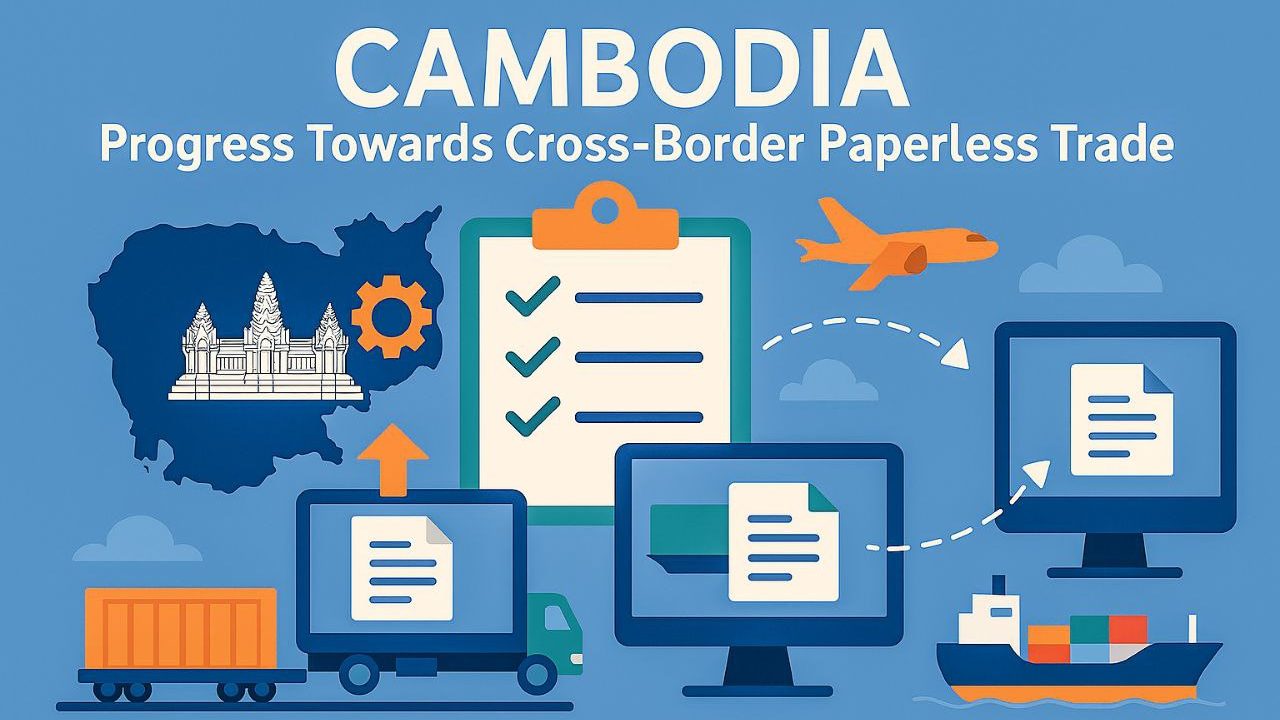
Cambodia is entering a decisive phase in its trade modernization journey. Over the past decade, the country has moved from foundational customs automation toward integrated digital trade facilitation systems. Today, the policy focus is shifting further from domestic digitalization toward trusted and interoperable cross-border paperless trade.
For development partners, government agencies, and regional institutions, Cambodia increasingly represents an important case study: a lower-middle-income economy moving rapidly from compliance-driven trade facilitation toward competitiveness-driven digital trade integration.
For Cambodia, cross-border paperless trade is no longer a future aspiration. It is becoming a core instrument for maintaining export competitiveness, strengthening supply chain resilience, and supporting long-term digital economic transformation.
Why Cross-Border Paperless Trade Matters for Cambodia’s Development Trajectory
Cambodia remains one of the most trade-dependent economies in Southeast Asia. As the country approaches graduation from Least Developed Country (LDC) status later this decade, structural competitiveness will increasingly depend on efficiency, predictability, and digital compliance capabilities.
Cross-border paperless trade addresses several structural constraints simultaneously. It reduces transaction costs, shortens clearance times, improves regulatory transparency, and enhances compliance risk management. More importantly, it enables trusted electronic data exchange between trading partners, a prerequisite for participation in digitally integrated regional value chains.
Regional modelling continues to reinforce the economic rationale. Across Southeast Asia, implementation of digital trade facilitation combined with seamless cross-border data exchange could reduce trade costs by 8.2%, according to the United Nations Economic and Social Commission for Asia and the Pacific / Asian Development Bank study.
The COVID-19 pandemic reinforced these lessons. During disruption periods, agencies expanded digital clearance, remote document processing, and electronic submission mechanisms. These experiences accelerated policy consensus around the need for interoperable cross-border digital trade frameworks.
Strong Policy Anchoring: Digital Economy and Trade Facilitation Convergence
Cambodia’s cross-border paperless trade progress is strongly anchored in national policy frameworks that increasingly converge around digital transformation.
Digital economy and digital government strategies now explicitly prioritize interoperability, secure data exchange, cybersecurity, and digital public service integration. These policy directions are critical because cross-border paperless trade is not only about customs; it requires whole-of-government digital governance maturity.
Legal frameworks have also evolved significantly. The E-Commerce Law and digital signature regulations now provide a legal basis for electronic records, authentication, and certification authorities. These instruments form the trust infrastructure required for cross-border recognition of electronic trade documents.
At the regional level, Cambodia’s policy direction aligns closely with initiatives under ASEAN digital integration frameworks and emerging regional digital economy agreements such as the Digital Economy Framework Agreement (DEFA). Alignment with these regional frameworks reduces duplication risks and accelerates cross-border interoperability readiness.
Cambodia has further strengthened its credibility in trade facilitation reform through the notification of full implementation of all commitments under the World Trade Organization Trade Facilitation Agreement (WTO TFA), positioning the country among a small group of developing economies that have completed the agreement’s implementation roadmap. This achievement provides a strong institutional and procedural foundation for advancing toward cross-border paperless trade and deeper regional digital trade integration.
Institutional Coordination toward Structured Reform Governance
Institutional coordination remains one of the most important determinants of successful cross-border paperless trade implementation. Cambodia has made significant progress through strengthened inter-agency coordination mechanisms, particularly through the National Committee on Trade Facilitation. This platform increasingly serves as the central coordination mechanism for sequencing trade facilitation reforms, aligning agency digitalization roadmaps, and facilitating public–private dialogue.
Operationally, key institutions such as the General Department of Customs and Excise and the Ministry of Commerce continue to drive much of Cambodia’s technical modernization, legal reform alignment, and regional interoperability engagement.
However, from a policy perspective, the next phase of reform will require expanding coordination beyond traditional trade agencies. Cross-border paperless trade requires consistent governance across data protection, cybersecurity, digital identity, electronic authentication, and interoperability standards – areas where mandates often remain distributed across multiple ministries.
Development partner support will be particularly important in this next phase, especially in strengthening whole-of-government digital trade governance models.
Operational Progress: Moving Beyond Digitalization
Customs digital transformation has been particularly advanced. Nationwide digital customs systems now support electronic declarations, automated risk management, and integrated customs processing across entry points. Complementary reforms include expanded electronic payment systems and digital transparency tools, including tariff and customs clearance handbook mobile applications.
The expansion of Cambodia’s National Single Window has also been transformative. The platform now connects 16 regulatory agencies and processes large volumes of regulatory documents electronically (over 240,000 regulatory documents in the first 11 months of 2025 compared to approximately 62,000 in 2019). This represents a major structural shift away from agency-specific submissions toward integrated regulatory clearance.
Critically, Cambodia has already exchanged selected trade data electronically with regional partners, including electronic Certificates of Origin (eCO) and ASEAN Customs Declaration Document (ACDD) exchanges. This marks a major milestone: transitioning from domestic digitalization toward operational cross-border interoperability.
Electronic advance data systems have also scaled significantly, particularly for maritime cargo, express shipments, and e-commerce consignments. These systems allow customs to perform risk assessments before goods arrive, reducing congestion, improving targeting efficiency, and increasing supply chain predictability.
Electronic payment adoption has grown rapidly, reflecting increasing trader trust in digital government systems and financial integration infrastructure. High digital payment adoption is often a strong indicator of broader digital ecosystem maturity.
Private Sector Perspectives: Positive Direction, Realistic Expectations
Consultations with logistics providers, customs brokers, express operators, exporters, and digital platform providers consistently indicate strong support for Cambodia’s digital trade direction.
Businesses increasingly report improvements in clearance transparency, document traceability, and processing predictability. Electronic submission systems reduce physical administrative burdens and improve compliance management.
At the same time, the private sector consistently signals that the next phase of reform should prioritize stronger cross-border document recognition frameworks, clearer interoperability standards, consistent implementation across agencies and checkpoints, and stronger assurance around data protection and cybersecurity frameworks.
Importantly, SMEs require continued capacity support to fully participate in digital trade ecosystems. Without targeted support, there is a risk that digital trade reforms disproportionately benefit larger exporters and logistics operators.
For donors and development partners, this highlights a shift in support needs, from system development toward governance strengthening, regulatory alignment, and private sector adoption support.
Looking Ahead: From Digital Trade Readiness to Regional Digital Trade Integration
Successful cross-border paperless trade requires three layers of trust: technical interoperability, legal recognition of electronic documents across jurisdictions, and institutional cooperation among regulatory agencies across countries.
Cambodia has already made strong progress in legal foundations and technical system development. The next phase requires deeper engagement in regional and bilateral trust-building mechanisms. The policy focus should now shift toward cross-border trust frameworks, interoperability governance, and mutual recognition arrangements.
Regional cooperation platforms promoted by UN regional bodies and ASEAN provide important testing grounds for cross-border electronic document exchange, interoperability standard development, and mutual recognition pilots. These platforms reduce implementation risk by allowing countries to gradually scale cross-border paperless trade rather than attempting full implementation simultaneously.
If current reform momentum continues, Cambodia is well positioned not only to participate in cross-border paperless trade ecosystems but also to contribute actively to shaping regional implementation models for developing economies.
For policymakers, donors, and regional institutions, Cambodia represents a high-potential partner for piloting next-generation digital trade cooperation models.
The coming years represent a strategic window. With targeted governance strengthening, continued regional cooperation engagement, and sustained private sector partnership, Cambodia is well positioned to translate digital readiness into long-term digital trade competitiveness.
The analysis and views presented are intended to provide policy and technical insights, based on the author’s knowledge base and professional experience developed through various assignments supporting government agencies, development partners, and regional initiatives in Cambodia. It does not necessarily reflect the official positions of any affiliated institutions or partners. of Digital Trade Reform