

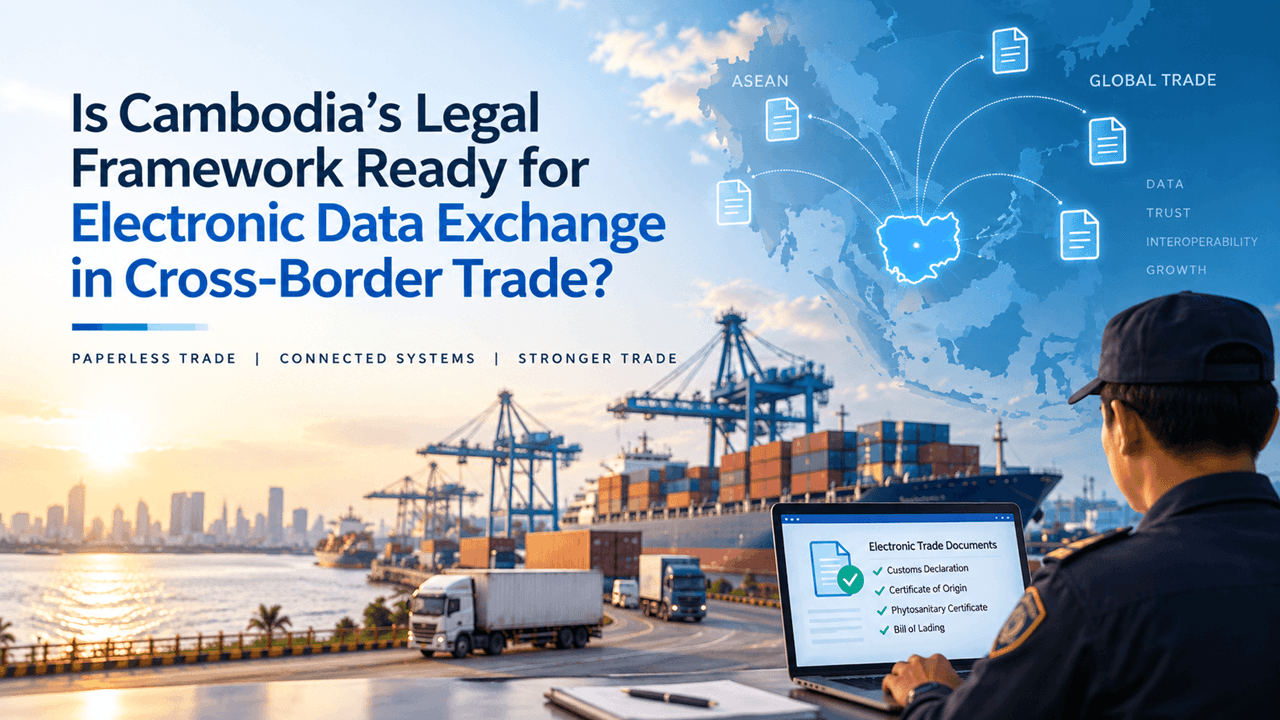
Electronic data exchange in cross-border trade is becoming increasingly important for Cambodia. When we talk about paperless trade, the conversation often focuses on technology: online platforms, electronic documents, APIs and data exchange. But before government systems can exchange information electronically, there is a more fundamental question: Do our legal frameworks allow them to do so?
For Cambodia, the answer is increasingly yes.
Over the past several years, Cambodia has developed a significant set of laws, regulations and digital platforms that provide the legal foundation for electronic transactions, electronic documents, government-to-government data exchange and interoperability. The challenge now is less about whether electronic systems exist, and more about how effectively the different pieces can work together.
Electronic information can have the same legal effect as paper
A fundamental building block is Cambodia’s Law on E-Commerce. It establishes that electronic communications should not be denied legal validity simply because they are electronic. Several provisions are particularly important:
- Article 5 recognises electronic communications.
- Article 6 provides that where the law requires information to be “in writing”, an accessible electronic record can meet that requirement.
- Article 7 provides the basis for recognising electronic signatures where they appropriately identify the person and indicate their approval.
- Article 8 allows requirements concerning the retention of information in its original form to be fulfilled electronically, subject to reliability and accessibility conditions.
- Articles 10–12 provide further support for the use, retention and evidentiary value of electronic records and contracts.
For cross-border trade, this matters because it removes a basic legal barrier to replacing paper documents with electronic records.
Customs law recognises electronic documents
The legal foundation also extends to customs. Article 9 of the current Customs Law recognises “documents” broadly enough to include information recorded, transmitted or stored by computer or other electronic means. Articles 10 and 30 provide the basis for establishing procedures governing customs declarations and supporting documentation.
This has helped support electronic customs processing through systems such as ASYCUDA. Electronic customs is therefore not simply an IT project; it operates within a legal framework that recognises electronic information as part of the customs process.
Cambodia’s National Single Window: connecting government processes
The next step is moving from individual digital systems to connected systems. Sub-Decree No. 59 on the National Single Window (NSW) provides an important legal foundation. Article 3 establishes the NSW as an electronic platform and single entry point. More importantly, Article 10 provides for interconnection with ministry and agency systems, while Article 11 provides for interconnection with the ASEAN Single Window and systems of trading partners for electronic data exchange in cross-border trade.
These provisions are significant because they move beyond simply putting individual government services online. They recognise that government systems need to connect with one another.
CamDX: the digital roads between systems
Cambodia has taken this concept further through Sub-Decree No. 164 on the Cambodia Data Exchange (CamDX). Its provisions establish a framework for secure and accountable data exchange:
- Article 1 establishes the framework for secure, transparent and accountable data exchange.
- Article 4 defines CamDX as a platform for secure data exchange using API connectivity between systems.
- Article 5 requires transactions to be encrypted, digitally signed and timestamped.
- Article 6 provides safeguards concerning data ownership.
- Article 12 establishes CamDX as the required channel for covered data exchanges.
Put simply, CamDX is helping create digital roads between government systems, a common mechanism through which systems can exchange information securely rather than each system having to build separate connections to every other system.
Building trust in electronic transactions and documents
Exchange is only useful if the information can be trusted. Cambodia is therefore also developing the infrastructure needed to answer three basic questions: Who is behind the transaction? Is the document genuine? Can it be trusted?
The Law on E-Commerce provides the broader legal basis for electronic signatures, while the Sub-Decree on Digital Signatures (2017) provides the framework for digital signatures and related trust services. Certification Authorities (CAs) are an important part of this ecosystem, helping establish the link between a digital signature and the identity of the person or organisation behind it. CAs and trust services are areas that Cambodia continues strengthening as electronic transactions and cross-border recognition develop.
CamDigiKey, established under Sub-Decree No. 207, provides an emerging digital identity and authentication infrastructure. Its Article 13 provides safeguards for the security, privacy, confidentiality, integrity and accuracy of CamDigiKey data. The platform is already being used for e-KYC verification by approximately 50 financial institutions, showing that this infrastructure is moving into practical use.
Verify.gov.kh, established under Sub-Decree No. 52, provides a way to verify government-issued electronic documents through standardised, verifiable QR codes. While CamDX helps systems exchange data, Verify.gov.kh helps users check whether a document is authentic and valid. The model has also been introduced in several partner countries, providing useful experience for future cross-border cooperation.
Together, these are complementary parts of Cambodia’s emerging digital trust infrastructure: digital signatures and CAs help establish trust in the signer; CamDigiKey helps establish digital identity; and Verify.gov.kh helps verify the document.
The pieces are there, but are they connected?
Looking at these developments together, Cambodia has established many of the building blocks of a trusted digital trade environment. But having the pieces does not automatically mean that the whole system is interoperable.
Inter-agency system integration is still expanding. Some government agencies continue to operate hybrid paper-and-electronic workflows, while traders may still need to enter similar information into different platforms. The level of digitalisation and system integration also varies across regulatory agencies.
This means Cambodia’s interoperability challenge is becoming less about “Can the systems connect?” and more about “Are agencies ready and able to use those connections consistently?”
That requires common standards, coordinated governance, compatible business processes, secure digital identity and authentication, cybersecurity, data protection and trusted digital services.
From digital paperwork to genuinely paperless trade
The real test of Cambodia’s digital transformation is whether businesses can experience the benefits of these systems in practice.
One important measure is the “once-only” principle: when information has already been submitted and validated, it should, where legally and operationally appropriate, be securely reused by another authorized government agency rather than requiring the trader to submit the same information again.
Cambodia is already seeing the potential of this approach. CamDX-supported interoperability has helped streamline business registration and reduce the need for citizens and businesses to repeatedly submit the same documentation across ministries.
The same principle can be applied more broadly to trade. A trader should not have to provide the same information separately to customs, a licensing agency and another regulatory authority when those agencies can securely exchange and reuse the information.
This is where interoperability becomes more than a technical concept. It is ultimately about making government services simpler for businesses: fewer forms, fewer submissions, fewer manual checks and less reliance on paper.
Cambodia has already put many of the legal and technical building blocks in place. The next challenge is to turn these building blocks into seamless and trusted electronic data exchange in cross-border trade.
That is when paperless trade will mean what it promises – not simply digital paperwork, but less paperwork altogether.
The analysis and views presented are intended to provide policy and technical insights, based on the author’s knowledge base and professional experience developed through various assignments supporting government agencies, development partners, and regional initiatives in Cambodia. It does not necessarily reflect the official positions of any affiliated institutions or partners. Featured images are generated by AI.